

Search engine optimization extends far beyond content creation, though; many believe that's where it ends. The real magic happens when you understand how technical elements like schema markup and meta tags work together with quality content.
Google's 2011 Panda update changed everything. This algorithm specifically targeted low-quality pages while elevating websites that truly served their audience. When you create content that genuinely outperforms what's already ranking, Google notices and rewards that effort.
At its core, SEO bridges the gap between what you offer and what people need. It helps search engines understand your content while giving users the information they need to decide if your site deserves their click. Every on-site element you optimize contributes to better visibility in organic search results.
On-page SEO forms the foundation of everything else you'll do. Each individual web page represents an opportunity to connect with your target audience. When you strategically place keywords and structure content with real people in mind, you create something that resonates with both human visitors and search algorithms.
This guide will walk you through the essential techniques that actually move the needle for your website's visibility. You'll discover practical methods that work! Not theories, but proven strategies that deliver results!
Understanding SEO Basics
What Is Search Engine Optimization?
Search engine optimization improves both the quality and quantity of traffic flowing to your website from search engines. This focuses on unpaid traffic—what we call "organic results".
Picture your website as a storefront on a busy street. SEO ensures people walking by can actually see you. When someone searches "best coffee shops," effective SEO helps your coffee shop website appear where it matters most—near the top of results.
The magic happens when search engines truly understand what you offer. SEO connects your content with people actively looking for solutions, products, or answers you provide.
Your primary goal should be ranking on the first page for keywords that matter to your business. Here's why this matters so much: the #1 result in Google's organic search captures an average 27.6% click-through rate.
Drop to second or third position and you're looking at just 18.7% and 10.2% respectively. Even more telling, a quarter of users never scroll past that first page of results.
How Search Engines Work
Search engines operate through three distinct phases, and not every page successfully makes it through each stage:
- Crawling: Automated programs called crawlers (sometimes called "spiders") systematically discover and download content from websites. When you publish that new blog post, Googlebot might find it by following a link from your homepage or through your sitemap.
- Indexing: Once crawled, search engines analyze and catalog your content in their massive databases. During this critical phase, they determine whether a page is duplicate content or the canonical (authoritative) version worth showing users.
- Ranking: When someone types in a search query, algorithms retrieve and arrange the most relevant results. Your coffee shop might rank prominently for "artisan espresso" if your content genuinely matches what searchers want to find.
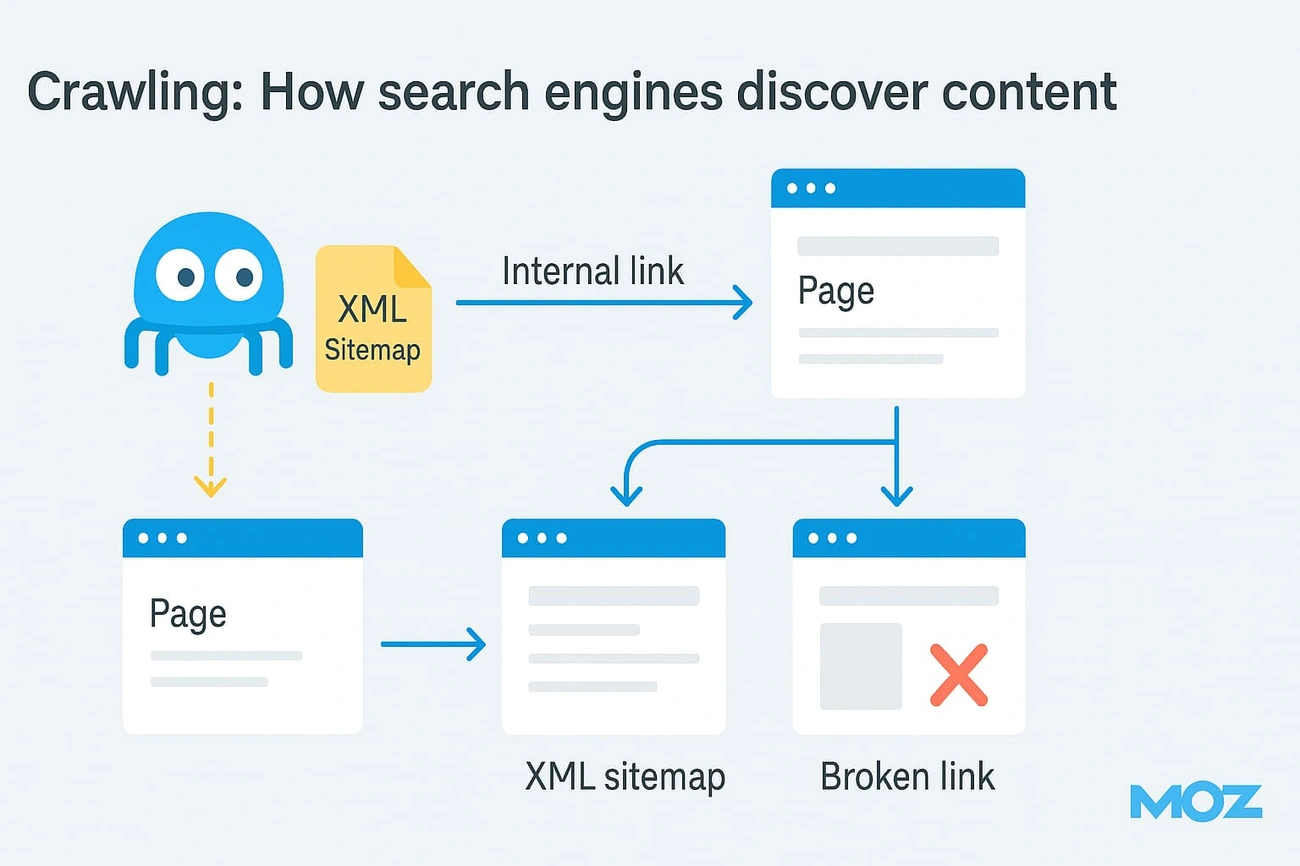
Google uses over 200 ranking factors in its complex algorithm. The search landscape never stays static because Google alone implemented over 500 algorithm changes in 2010 and the changes increase every year in keeping steps with advancement of technology and quality of searches.
Why SEO Matters for Beginners
Organic search drives 53% of all website traffic. More than half your potential visitors discover you through search engines.
Here's what makes SEO particularly powerful: unlike paid advertising, these benefits compound over time. When an ad campaign ends, the traffic stops flowing immediately. Quality SEO work continues delivering visitors months and even years later.
The numbers tell the story clearly. During 2023, search advertising accounted for 40% of online ad revenue in the United States. Businesses invest heavily in search visibility because it works.
SEO levels the playing field in ways many beginners don't realize. Your neighborhood coffee shop can outrank major chains by better serving what people actually search for.
Trust plays a huge role here too. Websites ranking well naturally appear more authoritative to users. People tend to trust sites that Google deems worthy of top positions.
Budget constraints don't have to stop you from seeing real results. Sometimes updating older content with fresh information can help you reclaim those valuable top rankings.
Most importantly, SEO connects you with people at the exact moment they need what you offer. When someone searches "how to brew pour-over coffee", your helpful guide can appear precisely when they're ready to learn.
Finding the Right Keywords
Keyword research sits at the heart of everything we do in SEO. It's where strategy meets reality in discovering exactly what your audience types into search boxes when they need what you offer.
How to Do Keyword Research
Start with what you know best: your business. List every product, service, and solution you provide. If you run that coffee shop we mentioned, think beyond "coffee" and try to consider something like "morning brew", "espresso drinks", or "caffeine fix".
Google becomes your research partner here. Type those initial terms into Google search and watch what it suggests. These suggestions come from actual questions people ask Google. These are real searches from real people.
The "People also ask" boxes and related searches reveal how your audience actually talks. They might search "best coffee near me" instead of "premium coffee establishments" and that difference matters enormously.
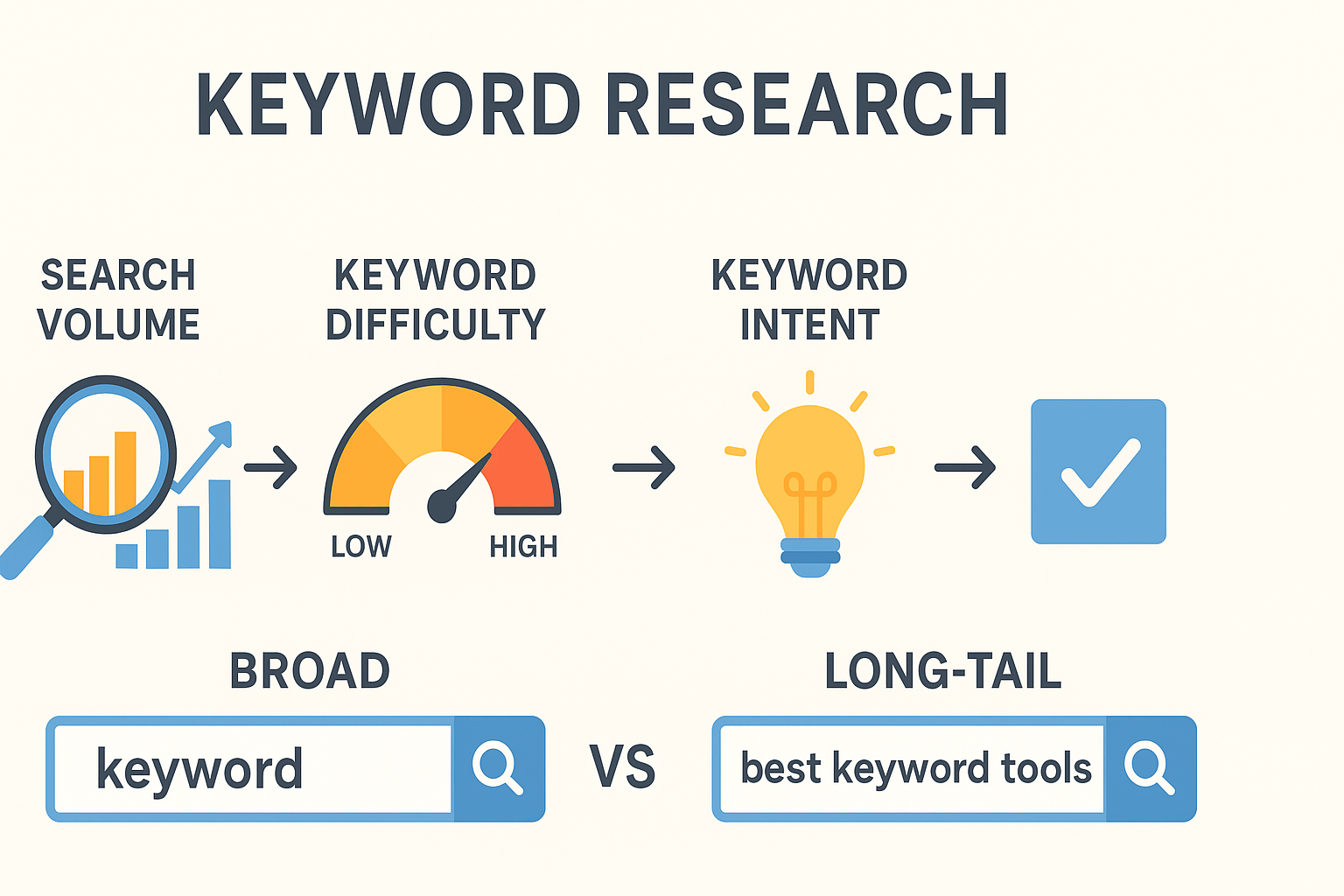
Short-tail keywords like "coffee" bring volume but fierce competition. Long-tail keywords such as "organic fair trade coffee downtown" have smaller audiences but convert better since they match specific user intent. Smart keyword research balances both.
The sweet spot? Terms with decent search volume that don't require battling industry giants. You want keywords that drive qualified traffic without demanding impossible ranking efforts.
Understanding Search Intent
Every search tells a story about what someone wants to accomplish. Search intent reveals the "why" behind the keywords.
Google has spent years perfecting its ability to match search results with user intent. The goal remains ranking pages that truly satisfy what people are looking for.
Four types of intent shape how people search:
- Informational intent: "How do I brew cold coffee at home?" This is someone who wants information.
- Navigational intent: "Starbucks store locator". This is a person who already knows what he/she wants and wants to find the location.
- Commercial intent: "Best coffee makers under $200". This is somebody who already has the required information and probably wants to buy.
- Transactional intent: "Buy coffee beans online". This person is ready to buy.
Words reveal intent immediately. "Buy," "deal," and "price" signal purchase readiness. Meanwhile, "how to," "guide," and "tips" indicate information seeking.
Check what's currently ranking for your target keywords. Google shows you exactly what it considers relevant. Product pages ranking for "buy espresso machine" confirm transactional intent, while how-to articles ranking for "espresso brewing techniques" reveal informational searches.
Using Keyword Tools Effectively
Quality tools turn keyword research from guesswork into science. They provide the data needed for smart decisions.
Google Keyword Planner offers a solid starting point with search volume estimates straight from Google itself. However, it lacks depth in competitor analysis and provides broad volume ranges rather than precise numbers.
Professional tools like Semrush, Ahrefs, and KWFinder deliver comprehensive insights: monthly search volumes, keyword difficulty scores, and cost-per-click data.
Note: Semrush and Ahrefs are too expensive for a starter in my opinion although they are really robust. These tools will serve agencies or big companies better. KWFinder is a lot less expensive and suits what they themselves call solopreneurs, freelance SEOs and startup marketers.
Keyword difficulty (KD) measures ranking competition by analyzing the link strength of currently ranking pages. Balance search volume against difficulty. You want terms people search for that you can realistically rank for.
Advanced features like Semrush's Personal Keyword Difficulty (PKD) factor in your site's specific authority to predict ranking chances. This personalized approach beats generic difficulty scores.
Tools inform your strategy, but don't let them control it. The best keywords connect your expertise with people who need exactly what you provide. That human connection remains more valuable than any algorithm.
Creating Content That Ranks
Quality content sits at the center of every successful SEO strategy. Google has made it clear that they reward websites that actually help people, not those gaming the system with algorithm tricks.
Writing for People and Search Engines
Writing exclusively for search engines belongs in the past. Modern algorithms evaluate content based on authenticity, trustworthiness, and human expertise. The shift happened because Google recognized that truly valuable content naturally satisfies both audiences.
Structure your content so readers can easily follow your ideas. Short paragraphs and clear headers make information digestible. When people stay engaged with your content, search engines take notice.
The sweet spot exists where user value meets search visibility. Your content should answer real questions while staying findable through search.
Example: A bakery website might publish a recipe guide that includes both helpful baking tips and naturally incorporates terms people search for, like "homemade sourdough bread recipe."
Using Keywords Naturally
Keyword stuffing destroys rankings faster than it builds them. Place your primary keyword naturally throughout your content, particularly within the first 100-150 words. This signals relevance without sounding robotic.
Vary your language to keep readers interested. Synonyms and related terms prevent repetition while strengthening your topic focus. Search engines understand context better when you use varied vocabulary around your main themes.
Entity-based SEO matters more since Google's helpful content update. The algorithm now grasps meaning beyond individual keywords, recognizing how concepts relate to each other.
Example: Rather than repeatedly using "best coffee maker," incorporate variations like "top brewing equipment," "quality coffee machines," or "premium coffee brewers."
Avoiding Duplicate and Thin Content
Pages with minimal value frustrate both users and search engines. Google flags content that offers nothing new, whether it's scraped material, duplicate information, or pages with barely any substance.
Remember the Panda update? It specifically went after sites publishing low-quality content, and those penalties still affect rankings today. Duplicate content creates confusion about which page should rank, often resulting in none of them performing well.
Multiple versions of the same content compete against each other. Search engines can't determine which deserves the top spot, so they may penalize all versions.
Example: Instead of creating five nearly identical product pages with slight variations, develop one comprehensive page with unique descriptions and specifications for each model.
Note: There are times when, for some reasons, you publish a content that is very similar to another one on your website. In that case, you may want to implement canonical tags to make the search engines distinguish your most important content, so you can avoid duplicate content penalties.
Updating Old Content for Relevance
Content marketers who refresh existing posts see twice the success rate compared to those who only create new material. This approach makes sense when you consider the advantages:
- The topic has already proven successful
- It requires less work than starting from scratch
- The URL retains existing SEO value
- It's easier to promote to previous readers
- Focus on posts that rank just outside the first page or show declining traffic patterns. These represent your best opportunities for quick wins. Keep the original URL whenever possible to preserve any backlinks and domain authority you've built.
Example: A fitness blog with a 2022 article on "Best Home Workout Equipment" could update it with new products, fresh statistics, and improved recommendations rather than creating an entirely new post.
Content that genuinely helps people will always outperform content created just to rank. Search engines reward sites that earn user trust through consistent value delivery.
Optimizing On-Page Elements
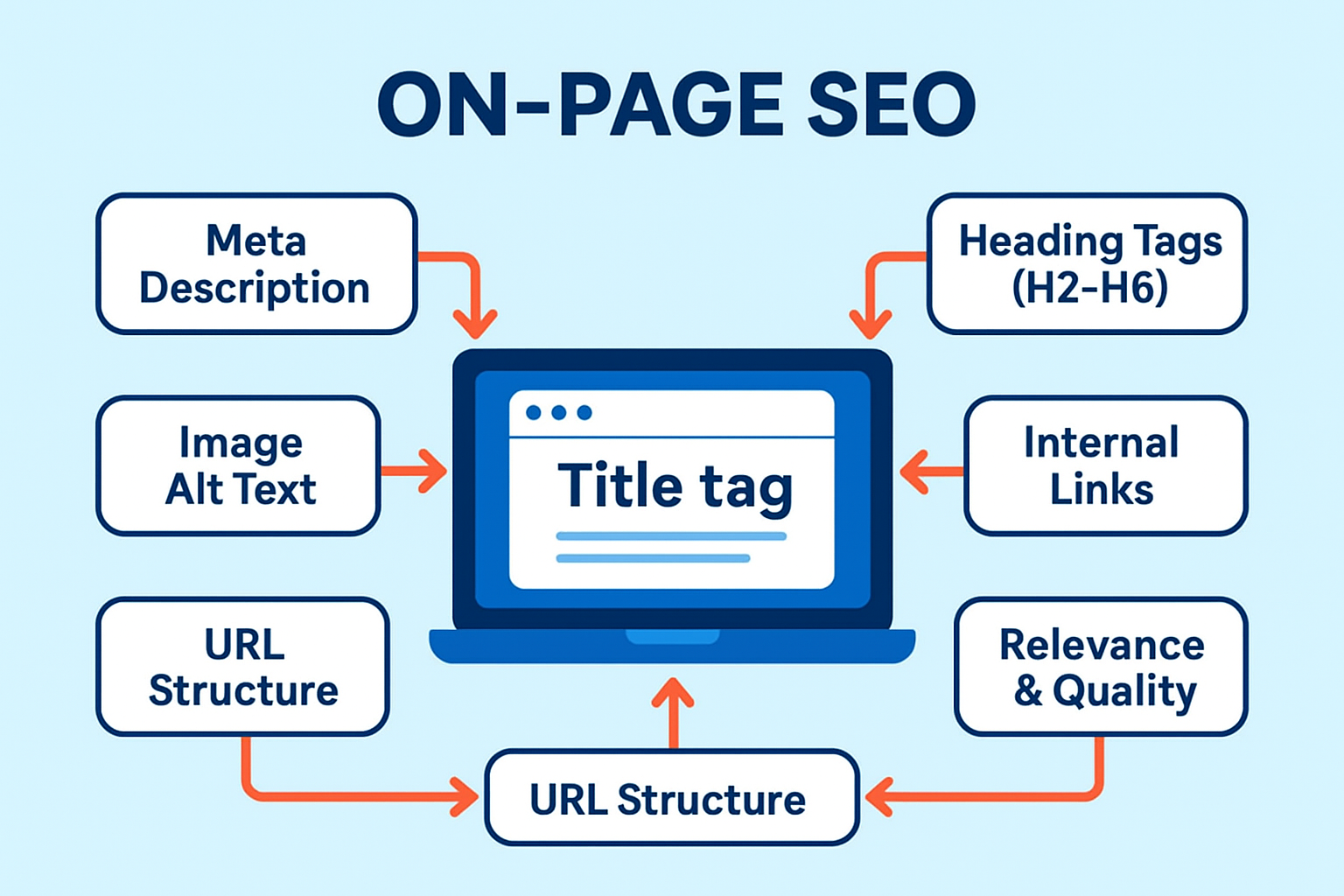
Quality content gets you halfway to your goal. The other half lives in the technical details that most people overlook. These HTML components work like a well-organized filing system, helping search engines categorize your content while giving users clear signals about what they'll find.
Title Tags and Meta Descriptions
Your title tag represents the first handshake between your content and potential visitors. It appears as the clickable headline in search results, browser tabs, and social media shares. This single element carries tremendous weight in determining whether someone clicks through to your site.
Smart optimization means placing your most important keywords near the beginning while keeping the entire title under 60 characters to prevent truncation. Moz's research shows that 90% of title tags under 60 characters display correctly in search results.
Google's John Mueller has directly confirmed that titles function as important ranking factors. Each page deserves a unique, descriptive title that accurately reflects what visitors will discover.
Example: A yoga studio might use "Morning Vinyasa Classes | Peaceful Mind Yoga" rather than simply "Classes | Yoga."
Meta descriptions work differently. They don't directly influence rankings, but they absolutely affect whether people choose your result over competitors. Think of them as your elevator pitch in search results.
The sweet spot falls between 50-160 characters. Include your target keyword naturally and always end with a clear call to action.
Example: "Explore our gentle morning vinyasa classes designed for all skill levels. Book your first session today and experience the difference!"
Header Tags (H1, H2, H3)
Headers create the roadmap that guides readers through your content. Without proper structure, even the best information becomes difficult to follow.
Your H1 tag should appear once per page and capture your main topic. From there, H2s mark your major sections, while H3-H6 tags handle subsections.
John Mueller from Google described header elements as a "really strong signal" that helps Google understand your page's topics. This matters for both user experience and search performance.
Screen readers rely heavily on header structure to help visually impaired users navigate content. Proper headers make your site accessible to everyone.
Example: For an article about coffee brewing, you might use:
- H1: Complete Guide to Brewing Perfect Coffee
- H2: Choosing the Right Beans
- H3: Understanding Coffee Roast Levels
URL Structure and Best Practices
URLs communicate expectations before users even click. SEO experts consistently rank them among the strongest on-page ranking factors after content quality.
Well-structured URLs reflect your site's organization and topic hierarchy. They provide search engines with additional context about page relevance.
Keep URLs descriptive but concise, targeting 50-60 characters when possible. Use hyphens to separate words rather than underscores.
Example: Good URL: example.com/coffee-brewing/french-press-guide Poor URL: example.com/p=123456 or example.com/coffee_brewing_french_press_guide
Including your primary keyword in the URL strengthens relevance signals. Avoid keyword stuffing or creating unnecessarily deep folder structures.
Always use lowercase letters to prevent duplicate content issues. This simple practice eliminates potential redirects and 404 errors that frustrate users.
Your page's purpose should align across your title tag, URL, content, and image alt text. This consistency reinforces topical relevance and builds trust with search engines.
Individual on-page elements might seem small, but they work together to create something much larger. Master these technical foundations first, and your content will have the best possible chance to reach its intended audience.
Improving User Experience
Search engines evaluate websites based on how visitors actually interact with them. Google rewards sites that people find genuinely useful and easy to navigate.

Page Speed and Mobile Friendliness
Site speed affects your bottom line more than most business owners realize. Websites taking longer than 3 seconds to load lose over half their mobile visitors.
Each additional second of delay can slash conversion rates by up to 20%. Google recognized this connection early, making page speed a ranking factor in 2010 and amplifying its importance with the 2018 Speed Update.
Practical speed improvements include:
- Compress images without quality loss
- Minify CSS, JavaScript, and HTML files
- Enable browser caching
- Use a content delivery network (CDN)
- Upgrade hosting when necessary
Example: A photography portfolio reduced load time from 6 seconds to 2.5 seconds through image optimization and caching. Their bounce rate dropped 30% within weeks.
Mobile traffic now represents over 55% of global website visits. Google's mobile-first indexing means they primarily evaluate your site's mobile version for ranking purposes.
Your content must work flawlessly across all screen sizes. Visitors should never need to pinch, zoom, or struggle to read your pages.
Example: A local restaurant redesigned their menu page with mobile-responsive elements. Customers can now quickly browse daily specials without frustration, leading to more phone orders.
Internal Linking for Navigation
Smart internal linking helps visitors discover more of your content while showing search engines which pages matter most. The way you connect pages influences how authority flows throughout your site.
Different link types serve specific purposes:
- Navigation links (main menus and sidebars)
- Breadcrumb links (showing page hierarchy)
- Related content links (suggesting further reading)
- Call-to-action links (guiding user actions)
Well-planned internal links keep visitors engaged longer, which search engines notice and reward.
Example: A cooking blog strategically links recipes within ingredient guides. Readers exploring "Fresh Basil Uses" immediately discover relevant pasta and sauce recipes, extending their session time.
Image Optimization and Alt Text
Images typically account for 50-90% of a page's total file size, making optimization crucial for performance. Choose the right format. Most people believe that JPEGs work best for photographs while PNGs suit graphics with limited colors. On the other hand though, I try to use the Google-recommended webp format if the platform I am using allows it.
Lazy loading delays image loading until they enter the viewport, dramatically improving initial page load times.
Alt text serves dual purposes: helping visually impaired users understand images while providing context clues for search engines. Descriptive alt text naturally incorporates relevant keywords without feeling forced.
Example: An online boutique reduced image file sizes by 60% through compression while adding descriptive alt text like "navy blue wool sweater with cable knit pattern." Both site speed and accessibility improved significantly.
Security Through HTTPS
HTTPS encrypts data between users and your website, protecting sensitive information like passwords and payment details. Secure sites actually load faster because HTTPS protocols handle security checks more efficiently than HTTP.
Google treats HTTPS as a ranking factor, giving secure sites a competitive edge. Browsers display trust signals like padlock icons for HTTPS sites, while flagging unsecured sites with warnings that increase bounce rates.
Example: An online community forum switched to HTTPS and saw bounce rates drop 15% immediately. New member registrations increased as users felt more confident sharing information.
User experience signals directly influence search rankings. Visitors who stay longer, explore multiple pages, and return frequently send positive signals that boost your site's authority.
Going Beyond the Basics
Once you've mastered the essentials, these advanced techniques can give your website a competitive edge that most businesses miss.
Using Schema Markup
Schema markup speaks directly to search engines in their native language. This specialized code helps them understand exactly what your content represents, which often translates into those eye-catching rich results you see in search pages.
The results speak for themselves; websites using schema markup see click-through rate increases of up to 30%. Rotten Tomatoes experienced a 25% boost in clicks after implementing their schema strategy.
Different schema types serve different purposes. Organization schema establishes your business credentials, Product schema showcases your offerings, Review schema displays customer feedback, and Local Business schema puts your location details front and center.
Example: A restaurant using LocalBusiness schema can display address, hours, and ratings directly in search results.
Targeting Featured Snippets
Featured snippets represent the ultimate search real estate—position zero, sitting above even the first organic result. These answer boxes satisfy user queries instantly while driving significant traffic to your site.
The opportunity here is substantial. Featured snippets capture approximately 8% of all clicks and appear in over 12% of searches. That's traffic you're potentially missing if you're not optimizing for them.
Success with featured snippets requires strategic formatting. Provide direct, concise answers in 40-50 words, structure content with clear headings, and remember that paragraphs dominate at 53.2%, followed by lists at 35.5% and tables at 11.5%.
Example: A fitness blog targeting "how to do push-ups correctly" with step-by-step instructions formatted as a numbered list.
Tracking SEO Performance with Tools
Performance monitoring separates successful SEO campaigns from those that stagnate. Regular analysis helps you catch problems before they damage your rankings and identify opportunities others overlook.
Site crawlers become your early warning system, flagging broken links, redirect chains, and speed issues that could hurt your visibility. Google Search Console provides invaluable insights into how search engines interact with your pages.
Log file analysis reveals the complete picture of search engine behavior on your site. You'll discover which pages get crawled most frequently and spot indexing issues that might otherwise remain hidden.
Example: An online store discovered through crawl data that product pages weren't being indexed, fixed the issue, and saw a 40% traffic increase.
Performance data drives smart decisions. When you know what's working and what isn't, you can focus your efforts where they'll deliver the biggest impact for your business.
Conclusion
SEO mastery doesn't happen overnight but that's exactly what makes it so rewarding. Every optimization you implement builds upon the last, creating momentum that compounds over time.
The techniques covered in this guide represent years of testing, refinement, and real-world application. Each strategy has proven its worth through countless websites that have climbed from obscurity to page-one visibility.
What matters most is taking that first step. Whether you start with keyword research, optimize a single title tag, or improve your site's loading speed, action beats perfection every time. The local bakery example we discussed earlier started with just one small change and that 30% click increase happened because they began somewhere.
Quality always wins in the long run. Google's algorithms grow more sophisticated each day, but they consistently reward websites that serve their audiences well. When you focus on creating genuinely helpful content and providing exceptional user experiences, rankings follow naturally.
Your SEO journey is unique to your business, your audience, and your goals. The coffee shop owner who concentrated on local keywords achieved remarkable results because they understood their specific market. Your path may look different, but the principles remain the same.
Stay curious. Search engines evolve constantly, and what works today may need adjustment tomorrow. But the foundation you are building by creating high-quality content, implementing solid technical optimization, and building genuine value for your visitors will serve you well regardless of algorithm changes.
Most importantly, remember that behind every search query is a real person seeking answers. When you help them find what they need, you're not just improving your rankings; you're making their day a little better. That's the true power of search engine optimization done right.
Key Takeaways
Master these essential SEO fundamentals to boost your website's visibility and drive organic traffic that converts.
- Focus on user intent over keywords - Create content that genuinely answers what people are searching for, not just what ranks well
- Optimize technical elements systematically - Perfect your title tags, meta descriptions, and URL structure to signal relevance to search engines
- Prioritize mobile-first user experience - Ensure fast loading speeds and responsive design since 55% of traffic comes from mobile devices
- Build internal linking strategy - Connect related pages to keep visitors engaged longer and help search engines understand your site structure
- Track performance and adapt continuously - Use tools like Google Search Console to monitor what's working and refine your approach based on data
SEO success comes from balancing technical optimization with genuine value creation. When you solve real problems for your audience while following search engine best practices, rankings and traffic naturally follow. Start with one area, measure results, and gradually expand your optimization efforts for sustainable growth.